AI Revenue Infrastructure

Gong defined revenue intelligence. Ergo is what comes after it.

Gong put revenue intelligence on the map, then stacked apps and AI agents on a legacy base built in 2015. Ergo is one unified context layer for your revenue org: every call, meeting, email, Slack thread, and cold call, connected to your CRM. Analysis and action on the same context.

Book a demo
!

Under contract with Gong? Run Ergo alongside it until renewal, or replace it outright. How consolidation works ↓

Coaching scorecards
Forecast and deal risk
Automatic email drafting
CRM updates
Pre-call research
Call recording
Switched from Gong

Solidroad ran on Gong for over a year, then replaced it with Ergo.

~10 h
~1 h

Post-call CRM admin, per rep, per week

~3-5%
100%

Calls reviewed for coaching

±25%
±5%

Forecast variance vs actuals

“Moving to Ergo from Gong is one of the highest-leverage revenue decisions we've made. Ergo doesn't just record our conversations, it runs our revenue motion.”
Mark Hughes
Mark Hughes
Co-Founder & CEO, Solidroad

Trusted by fast-growing teams

How Ergo works

What Ergo does with your deal conversations

Ergo is AI Revenue Infrastructure, built around one idea: everything a go-to-market organization says and hears should live in one place, a unified context layer connected to your CRM. That layer is the reason everything else works.

For leaders, that means pipeline visibility that reflects reality and a forecast you can defend.

Calls
Meetings
Email
Slack threads
In-person meetings
Ergo
Unified context layer
Connected to your CRM
Forecast and pipeline risk
Coaching and enablement
Lost reasons, objections, and requests
CRM hygiene and deal execution
Cross-functional handoffs
Upsells and renewals
01
Forecast and deal risk

A forecast you can open up and check

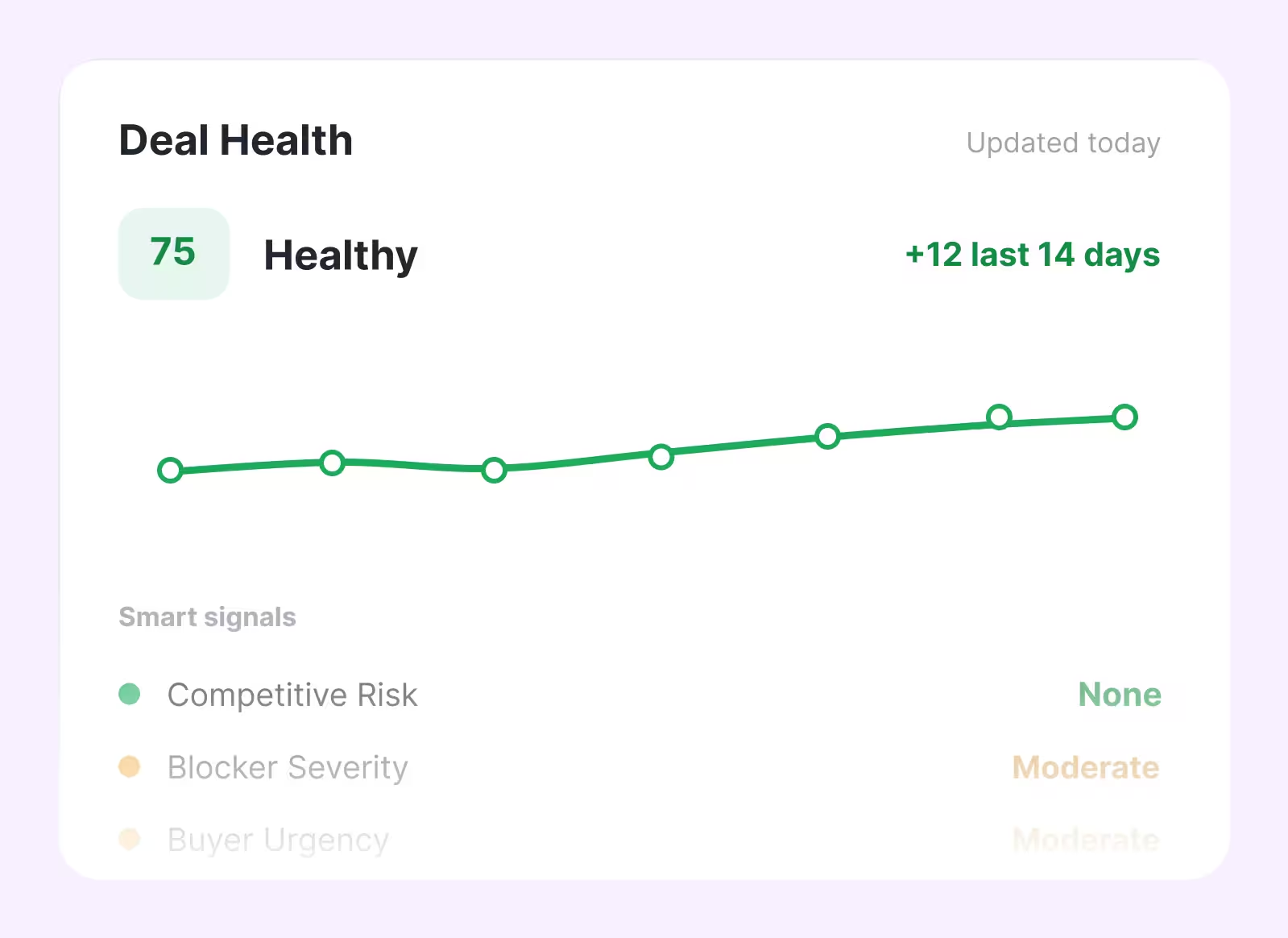
Ergo connects the forecast view to the deal-level evidence underneath it. Every signal is source-backed, so when a number gets challenged, you can open the conversation behind it.

  • At-risk deals flagged early, with the reason attached
  • Signals like competitive risk and buyer urgency, each with its source
“We used to spend more time fixing Salesforce than using it. With Ergo we have clean, current, and complete data on our pipeline and know nothing is slipping through the cracks.”
Anthony Hwang
Anthony Hwang
Director of Revenue Operations, Rho
Ergo deal health score of 75, healthy, up 12 points in 14 days, with smart signals for competitive risk, blocker severity and buyer urgency
02
CRM updates

Your CRM, written to your definitions

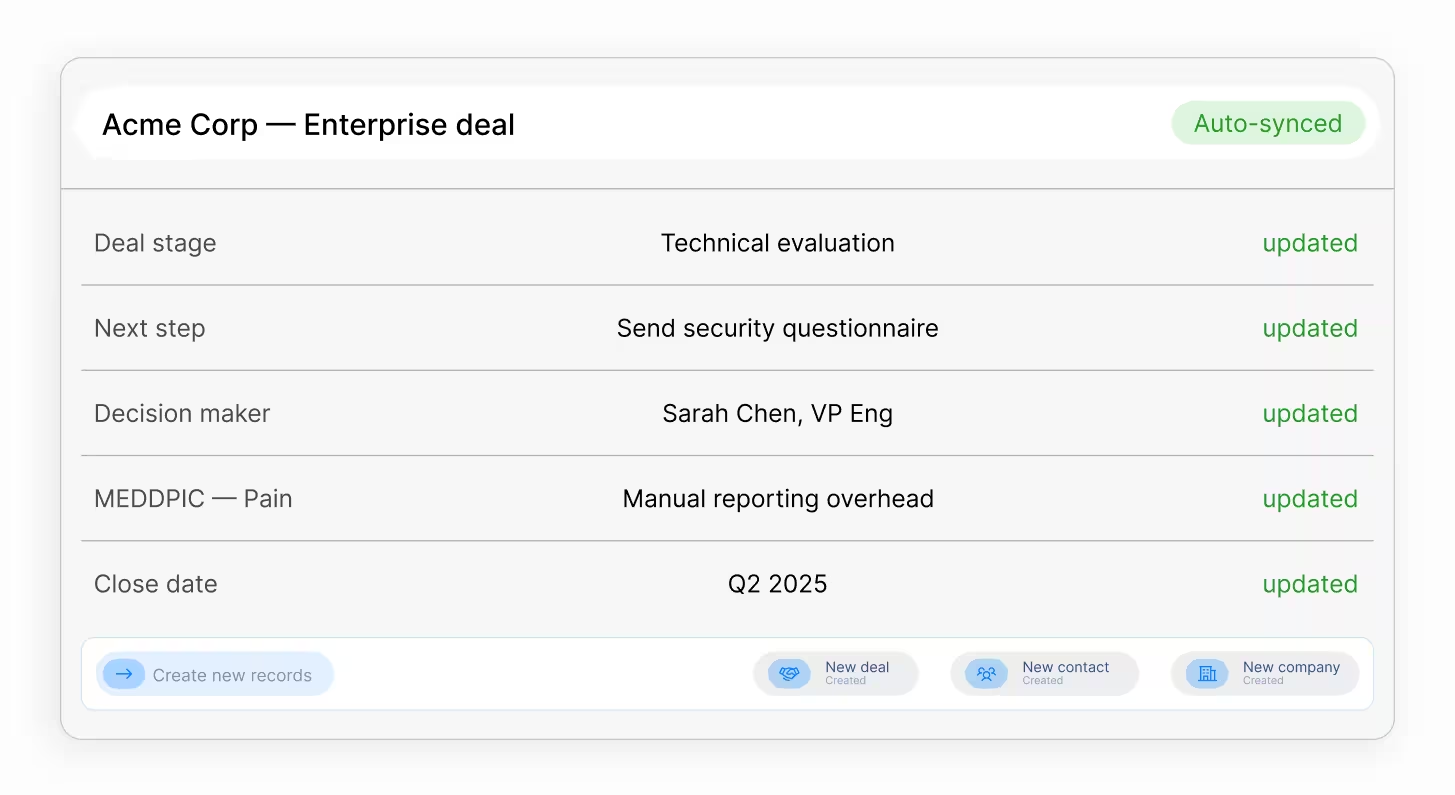
Ergo writes the CRM under rules you set, with field-level write controls and stage guardrails. For example, "Close date" can update only when the prospect confirms a target quarter, so the pipeline matches how you actually sell.

  • Fields written within two to five minutes of the call
  • A Slack change log for every field that changed
  • Missing records created, with a duplicate check first
  • Follow-up drafts in each rep's voice, about two minutes after the call
“Ergo gave us true revenue intelligence + execution. Our CRM stays accurate automatically, deal risk is clear, and we know why deals are lost, and how to fix it. One of the best revenue tools I've used.”
Tommy McNulty
Tommy McNulty
CRO, Rho
Ergo deal view: stage, next step, decision maker, MEDDPIC pain and close date updated automatically, with new deal, contact and company records created
03
Coaching

Every call scored against your methodology

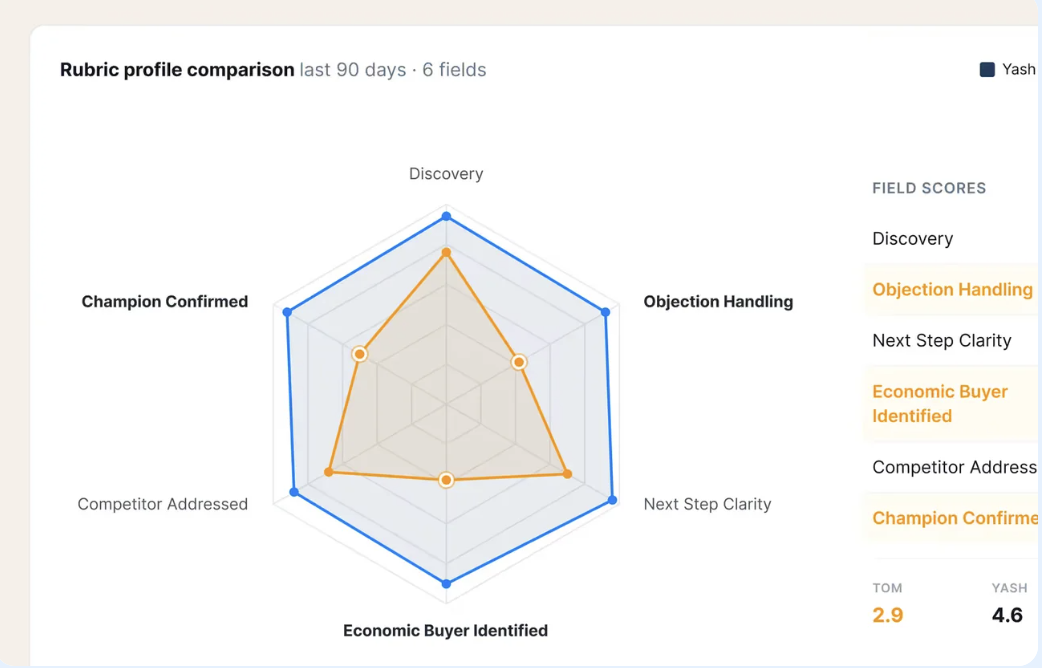
Ergo scores every call against your methodology and surfaces the moments that matter. Managers see where each rep stands, so coaching time goes to the middle of the pack.

  • A radar for each rep, next to your top performers
  • Flagged moments, ready for your one-on-ones
“Ergo did things I was wishing tools would do for the last 15 years. It helped our AEs and SDRs ramp about 30% faster, and from pilot to close, we increased success rates by about 10%.”
Vidhan Mittal
Vidhan Mittal
VP of Revenue, Retell AI
Ergo rubric profile comparison: a radar chart of one rep against a top performer, with field scores
04
Patterns across calls

See what buyers keep saying, quote by quote

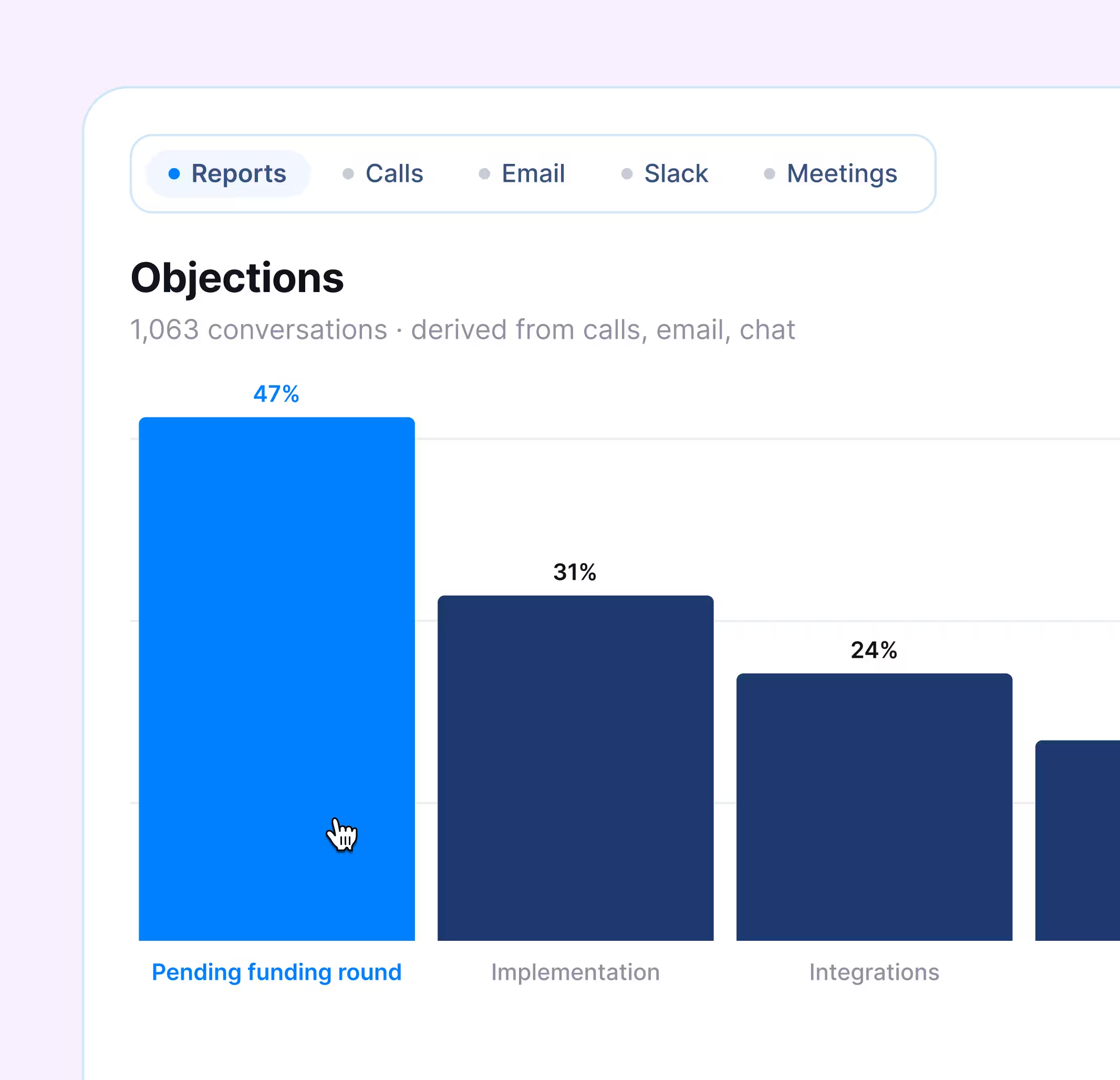
Ergo builds categories from what was said, with nothing to set up ahead of time. Click any category to see the exact quotes behind it.

  • Objections and competitor mentions, grouped for you
  • Real answers across thousands of conversations, traceable to the exact call
“Ergo flagged a new pipeline trend early, so we trained the team and stayed ahead of it. It didn't just show basic insights: it became our leading indicator.”
Will Schaffer
Will Schaffer
Head of Sales, Pylon
Sample Ergo objections report, split into categories, from calls, email and chat
Under contract with Gong?

Two ways to move off Gong

No rushed migration, and no starting from scratch. Connect your CRM, calls, meetings, and email, and Ergo backfills your existing records and history into the context layer on day one, Gong recordings included.

Book a demo
Bring your renewal date.
Option 1

Run alongside until renewal

Keep Gong until your contract ends. Ergo backfills your history and runs in parallel, so the layer is already full when you switch.

Option 2

Replace outright

Replace Gong entirely, as Solidroad did.

Ergo vs Gong

Gong is call recording with AI stitched on. Ergo is AI that happens to facilitate call recording.

Built for teams who liked what Gong showed them but wanted more from it.

Capability
Ergo
Gong
Built around modern AI, not retrofitted with it
Every capability runs on one AI-native foundation
Yes
No

AI layered onto a 2015 call-recording base

One context layer for the whole revenue org
Calls, meetings, email, Slack, in-person, and your CRM in one place
Yes
Partly

Call-centric, with email alongside

Acts on the deal instead of describing it
Writes the CRM, drafts follow-ups, moves the work forward
Yes
No

Surfaces insights for reps to act on

Comes to you before you ask
Risks, coaching moments, and signals surface on their own
Yes
No

Someone has to go dig

Understands your pipeline without being configured
Lost reasons, objections, and requests emerge from the conversations
Yes
No

Trackers and keywords an admin maintains

Judges each deal on what is actually unfolding
Forecast and risk from the substance of every conversation
Yes
No

Activity and recency heuristics, in a separate app

Fits your CRM, not the other way around
Custom objects, custom fields, new records, your definitions
Yes
Partly

Standard fields, from calls only

Carries context past the close
CS and post-sale inherit the whole deal, nothing to rewatch
Yes
No

CS catches up by rewatching the calls

Compounds over time, and comes with you
Your history is imported on day one and stays yours
Yes
No

Deleted 30 days after you leave

Customer stories

Teams that run their revenue on Ergo

One of the best revenue tools we’ve used, with truly game-changing AI

Tommy McNulty

Retell AI Was Leaking Millions in Revenue. Ergo Stopped It.

Vidhan Mittal, VP of Revenue, Retell AI

Solidroad swaps Gong for Ergo and gets its data working for the team.

Mark Hughes, Co-Founder & CEO, Solidroad
FAQ

Questions we hear from Gong users

Give your sales team their Sundays back.

What is the difference between Gong and Ergo?
+

It comes down to category. Gong is a Revenue AI OS rooted in revenue intelligence. Ergo is AI Revenue Infrastructure: the context layer underneath your revenue motion. Every call, meeting, email, and Slack thread lands in one place, connected to your CRM, and Ergo does both halves of the job. Analysis at scale, with coaching, reporting, and real answers across thousands of conversations. And action at scale, with accurate records, follow-ups that go out, and a forecast that stays current, under rules you set.

Gong already automates parts of the job. Why switch?
+

What Gong automates is the capture: recording, transcripts, summaries. Where it lacks depth is everything that operationalizes that data afterward. Writing the CRM to your definitions, including custom fields and objects. Reports that keep managers in the loop on pipeline movement and risk. Alerts that keep reps in the loop on which of their deals are slipping. Drafting and engaging the opportunities that need a follow-up. At Ergo those workflows are the product, not an add-on, and they all run off the same context layer under rules you set. RevOps gets control over every write, and leaders get a pipeline they can trust.

Why not just switch to a cheaper call recorder?
+

If call recording is all you need, do exactly that. A cheaper recorder is the right answer for that job. But in 2026, with what AI makes possible, most teams expect far more from that data: a forecast they can defend, CRM that keeps itself accurate, coaching on every call, lost reasons and objections that surface on their own, and context that follows the deal past the close. A recorder captures the conversation. Ergo is the layer that puts it to work.

Can Ergo run alongside Gong, or does it replace it?
+

Both work. Run Ergo alongside Gong until renewal, or replace it outright, as Solidroad did. Connect Salesforce or HubSpot, choose which fields Ergo can write, and switch over once you trust the pipeline it keeps. Reps don't have a new tool to learn.

What happens to our Gong call history?
+

It comes with you. Importing your Gong recordings and transcripts into the context layer is a standard step of onboarding, alongside your existing CRM records and email history. Plan the export early: under Gong's published data retention policy, your data is deleted 30 days after the customer relationship ends, and bulk export runs through its API or a separate app (Data Cloud). We'll map the export to your renewal date on the demo.

Does Ergo record calls, and what does it connect to?
+

Yes. Ergo records Zoom, Google Meet, and Microsoft Teams calls natively and reads email from Gmail or Outlook, plus your Slack threads. Everything lands in one context layer connected to Salesforce or HubSpot, and Outreach and Salesloft can receive the outputs.

Which teams is Ergo built for?
+

Both ends of the spectrum. Revenue teams inside unicorns and multibillion-dollar companies run on Ergo because the context layer holds up at their volume of calls, reps, and CRM complexity. Small teams run on it because it lets them stay lean: the CRM, the follow-ups, the coaching, and the forecast get done without adding headcount to do them. What they share is that they want the work done, not just reported on.

Book a demo